An introduction email has one job: give a stranger enough reason to reply. Most fail because they open with a long backstory and bury the request in the fourth paragraph. The person reading it decides in a few seconds whether to answer, so the best introductions are short, specific about why you are writing to this person, and clear about what you want next.
Below is a simple structure for how to introduce yourself in an email, 10 introduction email templates you can copy, subject lines that get opened, and the mistakes that get introductions ignored.
How to write an introduction email
Every good introduction email has the same five parts. Once you know them, you can write any introductory email in a few minutes.
1. A subject line that explains the email
The subject line decides whether the email gets opened. Name the connection or the reason: "Introduction from Priya at Acme", "Your talk at SaaS Summit" or "Question about your design internship". Leave out vague lines like "Quick question" or "Hello".
2. Who you are, in one sentence
Your name, your role and the one detail that matters to this reader. "I'm Maya, the new account manager for your team at Northwind" says enough. Your full career history can wait.
3. Why you are writing to them
Show you picked this person on purpose. Mention a mutual contact, a talk they gave, a post they wrote or a project at their company. One specific line does more than three general compliments.
4. One clear request
Ask for one thing that is easy to say yes to: a 15-minute call, an answer to a question, a look at a short document. If you ask for several things, people tend to answer none of them.
5. A short close and an easy way to reach you
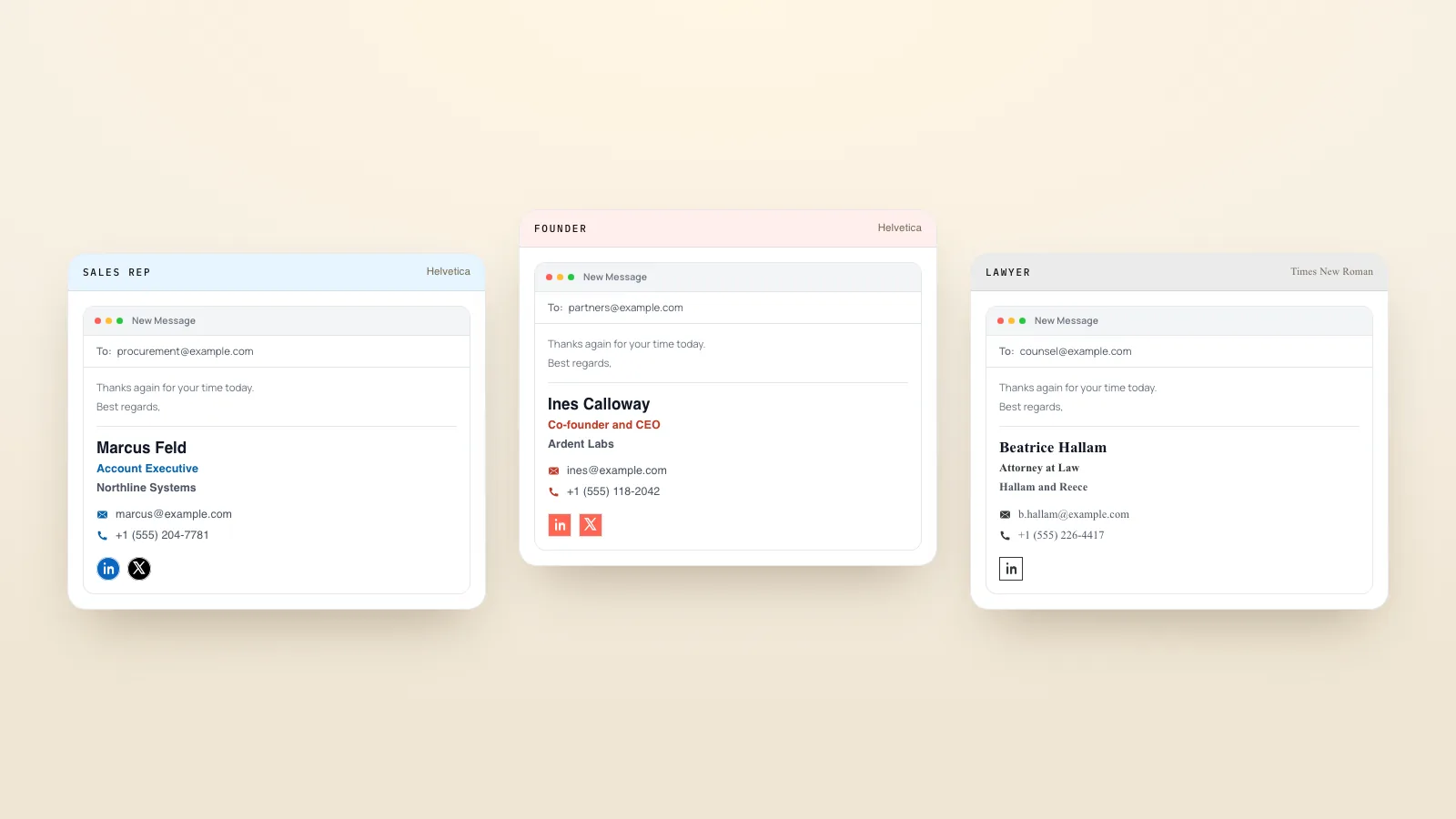
Thank them, sign with your name and role, and make your details easy to save. A signature with a link to your digital business card lets them save your phone, email and LinkedIn in one tap. You can make one free with the email signature generator.
10 introduction email templates
Copy a template, then change the parts in brackets. Each one is written to stay under 150 words.
1. Introducing yourself to a new client
Subject: Your new account manager at [Company]

Hi [Name],

I'm [Your name], and I'll be your account manager at [Company] from [date], taking over from [previous contact]. I've read through your account notes and know [project or priority] is the focus this quarter.

Could we have a 20-minute call next week so I can hear what is working and what you would change? I'm free [two time options].

Looking forward to working with you,

[Your name]

[Role, phone, card link]
2. Introducing yourself to a new team
Subject: Hello from [Your name], joining as [role]

Hi everyone,

I'm [Your name], and I've just joined as [role] on the [team] team. Before this I spent [number] years at [company] working on [area].

Over the next few weeks I'd like to meet each of you for 15 minutes to learn what you're working on and how I can help. I'll send calendar invites, but feel free to grab me any time.

Thanks for the warm welcome,

[Your name]
3. Business introduction email to a prospect
Subject: [Their company] and [specific problem]

Hi [Name],

I'm [Your name] from [Company]. I saw that [their company] [specific trigger: opened a new office, is hiring sales reps, launched a product].

We help [type of company] [one-line outcome]. For example, [one short, true example].

Would a 15-minute call on [day] make sense to see if this fits your plans?

Best,

[Your name]
4. Introducing yourself after a referral
Subject: Introduction from [Mutual contact]

Hi [Name],

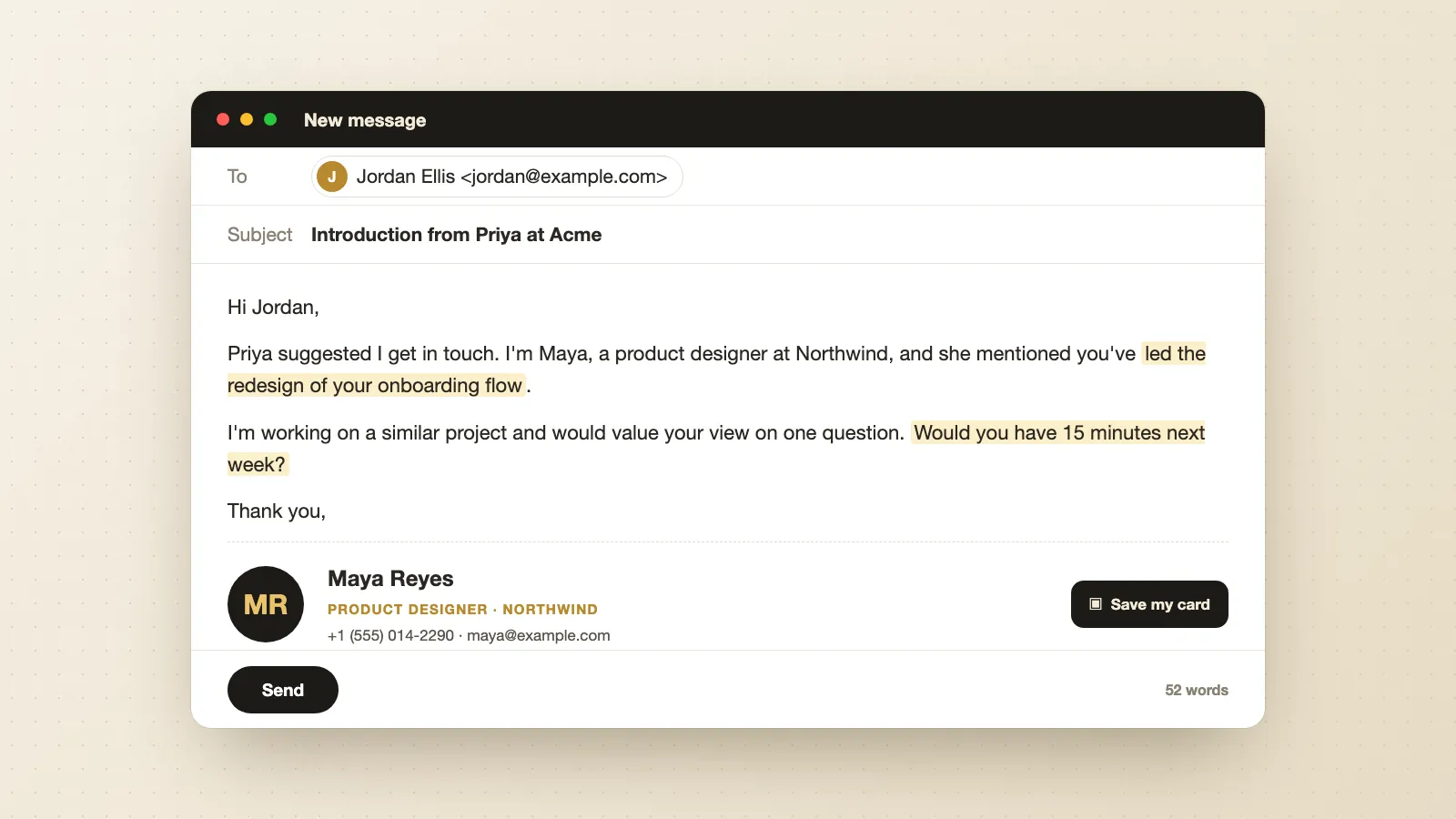
[Mutual contact] suggested I get in touch. I'm [Your name], a [role] at [Company], and she mentioned you've [relevant experience].

I'm working on [short description] and would value your view on [specific question]. Would you have 15 minutes in the next two weeks?

Thank you, and thanks to [Mutual contact] for connecting us,

[Your name]
5. Introducing yourself to someone you want to learn from
Subject: Your post on [topic]

Hi [Name],

I'm [Your name], a [role] at [Company]. Your post on [topic] changed how I [specific action], especially the point about [detail].

I'm trying to [goal] and would be grateful for one piece of advice: [specific question]. A two-line reply would help a lot.

Thank you for sharing your work,

[Your name]
6. Introducing yourself before an event
Subject: Meeting at [Event name]?

Hi [Name],

I'm [Your name], [role] at [Company]. I saw you're speaking at [Event] on [date] and I'll be there too.

I'd like to ask you about [topic] for 10 minutes. Would a coffee after your session work, or is there a better time?

Best,

[Your name]
7. Introducing yourself as a freelancer
Subject: [Service] for [their company]

Hi [Name],

I'm [Your name], a freelance [service] who works with [type of client]. I noticed [specific observation about their website, content or product].

I recently helped [client type] [result you can back up]. My portfolio is here: [link].

If you have a project coming up, I'd be glad to send a short proposal. Would that be useful?

Thanks,

[Your name]
First ask each person privately if they want the introduction. Once both say yes, send one email to both:
8. Introducing two people (double opt-in)
Subject: Introduction: [Name A] and [Name B]

Hi [Name A] and [Name B],

As promised, I'm introducing you.

[Name A], [Name B] is [role] at [Company] and has [relevant experience].

[Name B], [Name A] is [role] at [Company] and is working on [project].

I think you'd get a lot out of a conversation about [topic]. I'll let you two take it from here.

Best,

[Your name]
9. Asking someone for an introduction
Subject: Could you introduce me to [Name]?

Hi [Mutual contact],

I noticed you're connected to [Name] at [Company]. I'm hoping to learn about [topic] and think she'd be the right person to ask.

If you're comfortable introducing us, here is a short note you can forward: [two or three sentences about you and your request].

No problem at all if it isn't a good fit.

Thanks,

[Your name]
10. Introducing yourself to a new colleague in another team
Subject: Hello from [team]

Hi [Name],

I'm [Your name], the new [role] on [team]. I'll be working with your team on [shared project].

Could we have a quick chat this week so I understand how you like to work? Coffee is on me.

Best,

[Your name]
Introduction email subject lines
The subject line should tell the reader who you are or why you are writing. These formats work for most introductions:
- Introduction from [Mutual contact]
- [Mutual contact] suggested I reach out
- Your new account manager at [Company]
- Hello from [Your name], joining as [role]
- Your talk at [Event]
- Question about [specific topic]
- [Their company] and [specific problem]
- Meeting at [Event name]?
Keep subject lines short so they don't get cut off on phones, and avoid capital letters, exclamation marks and words like "urgent".
Introduction email mistakes to avoid
- Writing too much. If the email needs scrolling on a phone, cut it.
- Starting with "My name is". Your name is already in the From line. Start with your role or the connection.
- Making it about you. One line about you is enough; the rest should be about them and the request.
- Asking for too much, too soon. "Can you hire me?" gets ignored. "Can I ask you two questions?" gets answered.
- Sending the same email to everyone. One specific detail shows you wrote it for this reader.
- No follow-up. If there's no reply after a week, send one short, polite reminder.
What to do after you send it
If they reply, answer within a day and confirm the next step. If they don't reply after about a week, send one short follow-up that adds something useful, such as a link to the thing you mentioned. After one follow-up, let it go.
For the next stage, see how to follow up after a networking event. For booths and expos, use these trade show follow-up email templates.
Make your introduction easy to save
A good introduction email gets a reply. A good signature makes sure the reader can find you again. Add your digital business card to your email signature so every introduction carries your phone, email and LinkedIn in one link. Step-by-step guide.