
Most students hear "start networking" from a career adviser and picture a room full of strangers in suits. In practice, networking in college is smaller and easier than that. It is the professor who remembers your name, the alumna who answers your email, the classmate who sends you an internship posting because she knows you wanted one.
The networking tips for college students below are the ones that work on a student schedule: a few conversations a month, a short message after each one, and a simple way for people to find you again.
What networking means when you are a student
Networking is building relationships with people who know what you are good at and what you want to do next. For a student, those people are mostly a year or two ahead of you, a few years out of school, or teaching your classes.
You do not need a pitch deck or a job title. You need curiosity about other people's work, a clear sentence about your own interests, and the habit of staying in touch. A first-year student who has five real conversations with people in their field is ahead of a senior who collects 200 LinkedIn connections and talks to none of them.
12 networking tips for college students
1. Start with the people you already know
Your first network is the one you have: roommates, lab partners, teammates, people from your hometown, family friends. Tell them what field you are curious about. Students hear about internships, research spots and part-time jobs from each other long before they reach a job board.
2. Go to office hours with a real question
Professors and teaching assistants know people in their field, write recommendation letters and hear about research openings. Office hours are the easiest place to meet them. Bring a question about the material or about their own path into the field, and come back more than once so they connect your name and face.
3. Use your career center early
Many career centers run alumni mentoring programs, mock interviews, employer info sessions and career fairs, and some keep a database of alumni who agreed to talk to students. Book a meeting in your first or second year, before you need a job, and ask which events and alumni they would suggest for your major.
4. Join one club and take on a small role
Joining five clubs and going to none of them builds nothing. Pick one club, society or professional student chapter connected to your field and volunteer for something small: running the sign-up table, inviting a speaker, managing the group chat. Roles put you in touch with officers, faculty advisers and the guest speakers they bring in.
5. Reach out to alumni with a short, specific message
Alumni are the warmest strangers you will ever contact, because you share a school. Find them through your career center, your alumni platform or a LinkedIn search for your school and the company or job title you are curious about. Keep the first message under 100 words, say why you picked them, and ask one clear question. There is a template you can copy further down.
6. Ask for advice, not a job
An informational interview is a 15 to 20 minute conversation where you ask someone about their work. Ask how they got their first role, what a normal week looks like and what they would do differently as a student. People say yes to advice far more readily than to a job request, and the advice often turns into a referral later.
7. Prepare a 30-second introduction
At a career fair, a club event or a meetup, someone will ask "So what do you do?" Have two or three sentences ready: your year and major, what you are interested in, and what you are looking for right now. For example: "I'm a second-year computer science student. I've been building small data projects and I'm looking for a summer internship in analytics." For more formats, see these elevator pitch examples.
8. Make it easy for people to save your details
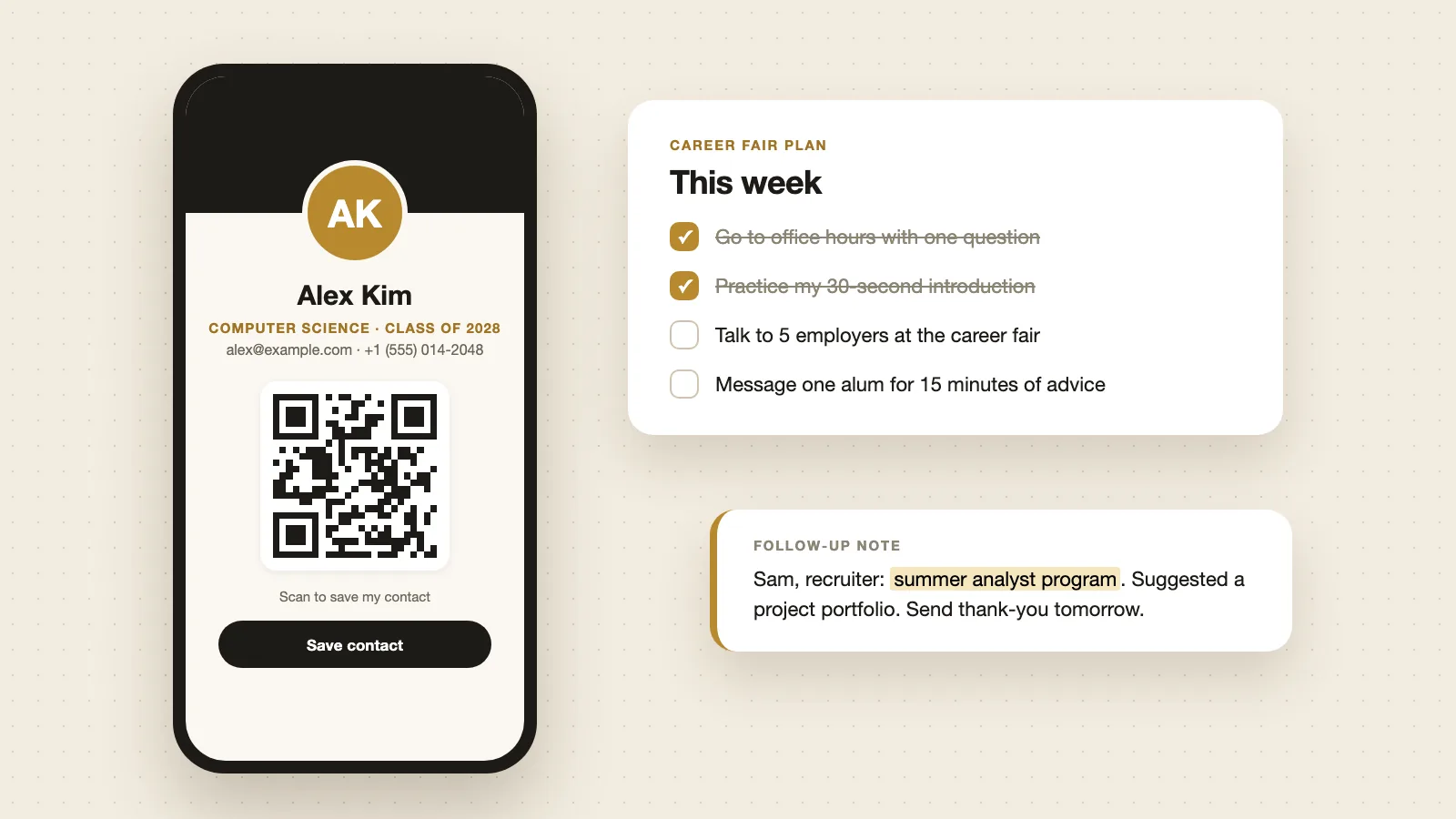
After a good conversation, the other person needs a fast way to keep your name and contact details. Spelling out an email address in a loud room fails more often than it works. A digital business card solves this: you show a QR code, they scan it with their phone camera and save your details, including your LinkedIn, without installing anything. You can make one free with the ConnectMachine digital business card maker.
9. Write down one detail after every conversation
You will meet more people than you can remember. Right after each conversation, note their name, where you met and one thing they said, such as a project they mentioned or a book they recommended. That detail is what makes your follow-up message personal. More tricks for this in how to remember names.
10. Follow up within a day or two
A short thank-you message the next day turns a conversation into a connection. Mention the detail you wrote down, thank them for their time and, if they offered something (an introduction, a link, a resume review), say you would welcome it. A step-by-step guide with examples.
11. Stay in touch when you do not need anything
The students with the strongest networks at graduation are the ones who kept in touch in between. Every few months, send a short note: congratulate someone on a new role, share an article related to a conversation you had, or tell a mentor that you took their advice and how it went. Two lines are enough.
12. Help other people first
Networking works both ways, even as a student. Share internship postings with classmates, introduce two friends who are interested in the same field, and offer to help at events. People remember who helped them, and those classmates will be working at companies you want to join in a few years.
How to network at a career fair
Career fairs are the one place where recruiters come to you. Prepare before you go:
- Get the list of employers in advance and pick five to eight you want to talk to.
- Read each company's careers page so you can ask something specific, such as which teams hire interns.
- Visit one lower-priority booth first to warm up.
- Open with your 30-second introduction and ask what the recruiter looks for in candidates.
- Before you leave each booth, ask for the best way to stay in touch and share your details by QR code or link.
- That evening, send a short follow-up to every recruiter you spoke with while you still remember the conversation.
LinkedIn for college students
LinkedIn is where recruiters and alumni will look you up after meeting you, so set up a basic profile before your first career fair:
- A clear, recent photo of your face against a plain background.
- A headline that says your major and what you are looking for, for example "Economics student | Interested in financial analysis | Seeking summer 2027 internship".
- A short About section in your own words.
- Your projects, part-time jobs, volunteering and club roles. Student experience counts.
- A personal note with every connection request: where you met and why you are connecting.
To let people find your profile in person, print or show a LinkedIn QR code. You can make one free with the LinkedIn QR code generator.
Networking apps and sites for students
You do not need many networking apps. These cover almost everything a student needs:
- LinkedIn: your professional profile, alumni search and messages to people in your field.
- Handshake: the career platform many US colleges use for jobs, internships and career fair sign-ups.
- Your school's alumni platform or mentoring program: ask your career center which one your school uses.
- Meetup and Eventbrite: local events, talks and meetups in your city, many of them free for students.
- Field-specific communities: GitHub for developers, Behance or Dribbble for designers, and Discord or Slack groups for your industry or club.
- ConnectMachine: a free digital business card you share by QR code or link, with voice notes and follow-up reminders for the people you meet.
Pick two or three and use them well. A complete LinkedIn profile and regular messages to real contacts do more than accounts on ten professional networking sites.
Networking messages you can copy
To an alumnus or alumna
Message
Hi Jordan, I'm a second-year marketing student at [your school] and saw that you went from [school] to brand strategy at [company]. I'm trying to understand what that path looks like. Would you have 15 minutes in the next few weeks for a quick call? Thank you, [your name]
To a professor after class
Message
Hi Professor Lee, I enjoyed today's lecture on behavioral pricing. I'd like to learn more about research in this area. Could I come to your office hours this week to ask about your work and any reading you'd suggest?
To a recruiter after a career fair
Message
Hi Sam, thank you for talking with me at the [school] career fair today about the summer analyst program. I appreciated your advice on building a portfolio of projects. I've applied through the careers page and would welcome any tips as the process moves forward. Best, [your name]
Networking mistakes students make
- Waiting until senior year. Relationships take time. Starting in your first or second year means you have people to ask when you need an internship.
- Asking for a job in the first message. Ask for advice instead.
- Sending the same message to everyone. One specific detail shows you did your homework.
- Collecting contacts and never following up. Ten people you talk to twice beat 200 connections you never message.
- Making yourself hard to reach. If someone has to search for you after meeting you, they often won't.