



How many professional connections can you actually maintain?
Dunbar's number puts the ceiling around 150 relationships. Your LinkedIn says 2,000. This gap is why most networks feel large and act small, and curation is the fix.
British anthropologist Robin Dunbar found that humans can maintain roughly 150 stable relationships: people you know, whose situation you remember, and with whom you share some history. The number comes from the size of our neocortex, and it has held up across societies, armies, villages, and companies.
Now look at your LinkedIn connection count. If you have been working for a decade, it is probably in the thousands. The gap between that number and Dunbar's 150 explains a familiar feeling: a huge network that somehow produces nothing when you actually need an introduction, a referral, or advice.
This guide covers what the research actually says, why collecting contacts is not the same as maintaining relationships, and how to run a self-curated personal network: a deliberately chosen set of people you keep track of on purpose, at a size your brain can actually sustain.
What Dunbar's number actually says
Dunbar's research describes not one number but a set of nested layers, each roughly three times the size of the last. The layers trade intimacy for reach: the inner circles get most of your attention, the outer ones get holiday-card levels of contact.
About 5: the support circle
The people you would call in a crisis. Professionally, these are the mentors and confidants who will tell you the truth about a job offer at 11pm.
About 15: close collaborators
People you trust deeply and talk to often. Former teammates, co-founders, the colleagues you would hire again without an interview.
About 50: the active network
People you genuinely keep up with. You know where they work, what they are building, and what they would want to hear about.
About 150: the stable edge
The outer limit of real relationships. You remember who they are and how you met, and one warm message could revive the thread.
Beyond 150 sit acquaintances and recognizable faces, up to about 1,500 people you can put a name to. They are not useless, but they are not relationships. They are potential relationships, and potential is only converted by attention.
Why your 2,000 connections produce nothing
Social platforms removed the cost of adding a connection, but they could not remove the cost of maintaining one. Attention did not scale with storage. So modern professionals carry enormous lists of dormant ties: people who accepted a request years ago and have not thought about them since.
A dormant tie has almost no transactional value at the moment you need it. Ask a stranger-with-a-connection-badge for a favor and you are effectively cold-emailing. The research on job searches and referrals consistently finds that value flows through ties with recent, remembered interaction, even weak ones, not through raw list size.

If you can genuinely maintain about 150 relationships, every contact you add beyond that is a decision about who silently drops out of the circle. Curation is not optional. It is just either deliberate or accidental.
Set the reminder while the conversation is still fresh.
Collecting is not connecting
Networking advice often optimizes the wrong step. Badge scans, connection requests, and fishbowls full of business cards measure collection. But roughly 88% of paper cards are discarded within a week, and a LinkedIn connection with no follow-up is the same event in digital form: an exchange that was never converted into a relationship.
The conversion moment
A contact becomes a relationship in the 48 hours after you meet, when you send the follow-up that references the actual conversation. Skip that window and the context evaporates for both of you.
The maintenance loop
Relationships stay alive through small, recurring touches: congratulating a job change, sending a relevant article, making an introduction. Fifteen minutes a week of deliberate touches maintains more network than a year of passive accumulating.
How to curate your network on purpose
1. Audit what you have
Go through your contacts and ask one question per person: if they messaged me tomorrow, would I remember who they are and be glad? Sort honestly into your active network, your stable edge, and everyone else.
2. Choose your 50 deliberately
Your active layer should reflect where your career is going, not just where it has been. Include people ahead of you, peers moving in parallel, and the people you are helping up behind you.
3. Capture context at the moment of meeting
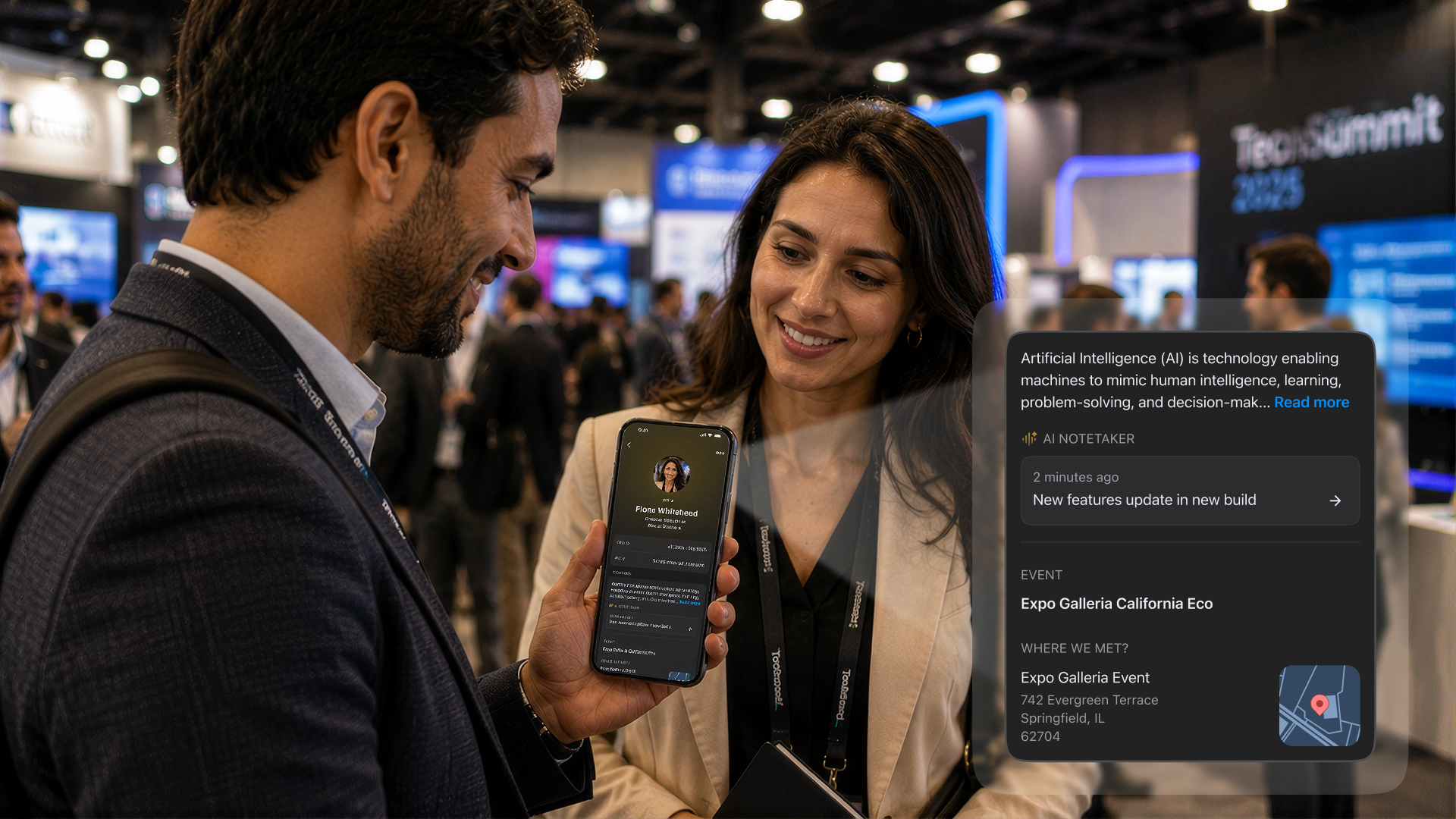
The details that make follow-up personal, what you discussed, what they are working on, what you promised, exist only briefly. Write them down when you exchange details, not at the end of the conference.
4. Schedule the maintenance
Do not rely on remembering. Set follow-up reminders when you meet someone, and put a recurring slot in your week for reaching out to people you have not spoken to in a while.
5. Let people go gracefully
A curated network implies an uncurated remainder, and that is fine. People you drop from active maintenance are not deleted from your life. They are acquaintances again, and a warm message can always promote them back.
Where tools fit, and where they do not
No app raises your Dunbar ceiling. What good tools do is stop the leaks below it: the contact whose context you lost, the follow-up you forgot, the promising person who never made it from a handshake into your contacts at all.
- Capture without friction: a digital business card exchange saves the other person's details at the moment of meeting, instead of hoping their paper card survives your jacket pocket.
- Context that persists: notes about where you met and what you discussed turn a name into a person six months later.
- Follow-up on schedule: reminders move maintenance from memory, where it fails, to a system, where it happens.
- Privacy as a feature: a self-curated personal network is yours. Choose tools that keep your contacts private by default and never sell your data, so curating your relationships does not mean broadcasting them.
The judgment, though, stays human. A tool can tell you that you have not spoken to someone in four months. Only you know whether that person belongs in your 50.
The bottom line
You cannot maintain 2,000 relationships, and pretending otherwise is how people end up with huge networks that cannot produce a single warm introduction. Around 150 is the honest ceiling, about 50 of those get real attention, and the professionals whose networks actually work are the ones who choose those 50 deliberately.
Stop measuring your network by its size. Measure it by how many people in it would answer your message within a day, and curate accordingly.
Frequently asked questions
What is Dunbar's number?
Does Dunbar's number apply to professional networks?
Are my extra LinkedIn connections worthless then?
How much time does maintaining a professional network take?
What is a self-curated personal network?
Curation over collection
